Circulating Tumor DNA Sequencing
Circulating Tumor DNA Analysis with NGS
Cell-free circulating tumor DNA (ctDNA) can act as a noninvasive cancer biomarker, offering a potential alternative to invasive tissue biopsies. Translational cancer researchers are investigating the use of liquid biopsies to detect ctDNA from tumors.1 ctDNA sequencing serves as a noninvasive approach for real-time monitoring of treatment response and identifying candidates for therapy.2
Next-generation sequencing (NGS) offers the sensitivity and specificity that researchers need to detect low levels of ctDNA in the bloodstream. In addition to targeting a single gene or a subset of genes, NGS can also identify genome-wide tumor-derived alterations in ctDNA.
ctDNA for Somatic Variant Detection
Traditionally, serum-based proteins have been used as cancer biomarkers for disease monitoring, but this method has limited utility, and does not provide information about driver mutations or tumor heterogeneity.1 Somatic mutations in tumor DNA offer a much more specific and accurate biomarker.
The advent of NGS and increased knowledge of genomic alterations associated with cancer are making it feasible to identify rare somatic mutations sensitively and accurately.
Advantages of NGS for Liquid Biopsies
Learn more about the benefits of NGS for liquid biopsy applications in cancer research. Understand the advantages of liquid biopsies over solid tissue biopsies, and explore common molecular technologies used to analyze ctDNA.
Read Application Spotlight
The Potential of Monitoring ctDNA with NGS
Circulating tumor DNA sequencing can help cancer researchers identify biomarkers associated with targeted therapies and study treatment responses.
The Potential of ctDNA Sequencing in Cancer
Companion Diagnostics
- Identify actionable alterations in tumors without an invasive biopsy
- Identify tumor heterogeneity
Monitoring for Therapeutic Response
- Determine treatment efficacy
- Test for new actionable alterations or resistance markers
Monitoring for Residual Disease
- Assess for potential disease remission or progression
Screening
- Determine presence of disease with no prior evidence
ctDNA Sequencing Research Articles
The Value of ctDNA and RNA Analysis
Dr Jo Vandesompele from Ghent University and Biogazelle discusses research on DNA-based liquid biopsy sequencing, RNA analysis, and the role of long non-coding RNA in cancer.
Read Article
Searching for Cancer Driver Gene Expression Clues in ctDNA
Whole-genome sequencing of ctDNA samples enables researchers to analyze nucleosome patterns and infer the gene expression status of cancer driver genes.
Read ArticleFeatured ctDNA Research Products
TruSight Oncology 500 ctDNA v2
Research assay targeting multiple somatic variant types from plasma, including tumor mutational burden and microsatellite instability.
View ProductTruSight Oncology UMI Reagents
These unique molecular identifiers reduce background noise in sequencing data, enabling detection of low-frequency variants.
View ProductNovaSeq 6000 System
Combines scalable throughput, speed, and flexibility for virtually any sequencing method, genome, and scale of project.
View SystemRelated Content
Cancer RNA Sequencing
This method provides functional information about cancer gene expression and the gene fusions that drive tumor progression.
Somatic Mutation Analysis
NGS offers high sensitivity, ease of use, and accurate data quality for identifying even rare mutations successfully.
Pan-Cancer Analysis
Expert-defined pan-cancer NGS panels can comprehensively assesses gene variants and abnormalities associated with many common cancers, regardless of tumor origin.
Learn More

ctDNA and Noninvasive Prenatal Screening Study
Researchers detected indications of maternal malignancies by analyzing cell-free DNA.
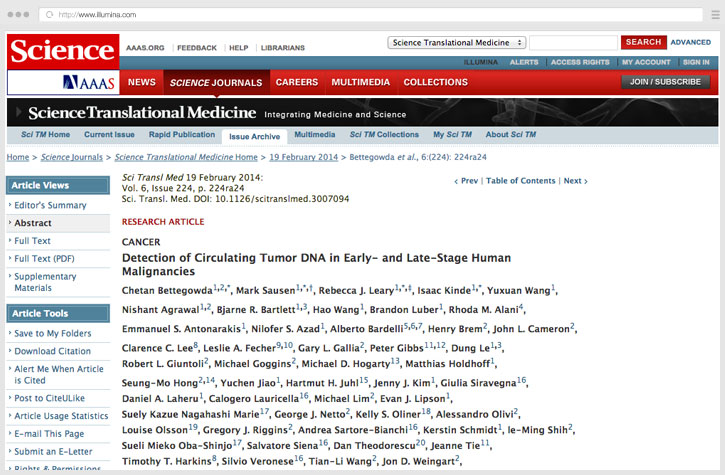
Detecting ctDNA in Early- and Late-Stage Human Malignancies
Bettegowda et al. demonstrate the use of ctDNA as a cancer biomarker in multiple tumor types.
Interested in receiving newsletters, case studies, and information on cancer genomics?
Sign Up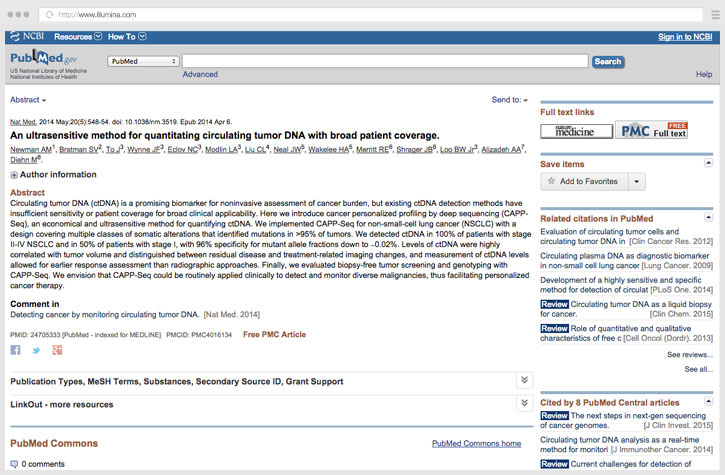
An Ultrasensitive Method for Quantitating ctDNA
Newman et al. introduce cancer profiling by deep sequencing (CAPP-Seq) for quantifying ctDNA.
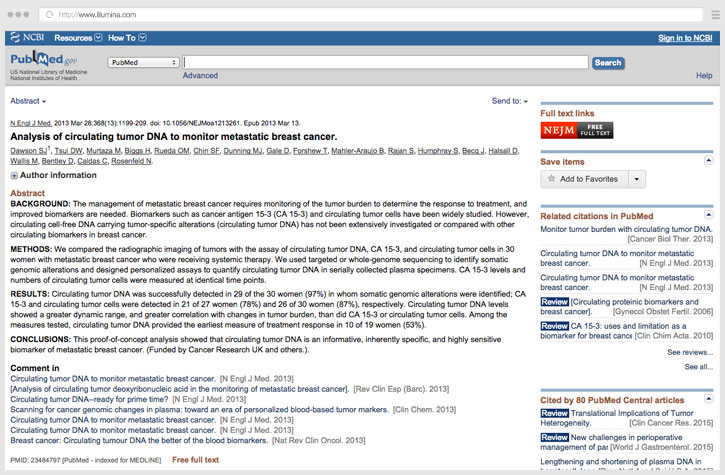
Analysis of ctDNA as a Metastatic Breast Cancer Biomarker
Dawson et al. use ctDNA to monitor metastatic breast cancer.

TruSight Oncology 500 ctDNA v2 on the NextSeq 2000 System
Enables in-house CGP research on a benchtop sequencing system.
References
- Bettegowda C, Sausen M, Leary RJ, et al. Detection of circulating tumor DNA in early- and late-stage human malignancies. Sci Transl Med. 2014;6:224ra24.
- DeMartin T (2014) Gene Trek: Clinical Impacts of Next Generation Sequencing. AG Scientific (info.agscientific.com/blog/bid/203182/Gene-Trek-Clinical-Impacts-of-Next-Generation-Sequencing)