June 4, 2026
The term “multiomics” may seem intimidating, and for good reason. This ambitious discipline has the power to reveal so much of the unknown. It has only been 23 years since scientists completed the Human Genome Project. This historical milestone opened the genomic floodgates. Following that breakthrough, 40 known rare genetic diseases grew to 7,000. But more than anything, we’ve learned just how much we don’t know.
From cancer to infectious disease to cardiovascular research, associated genes contain a host of crucial insight, but they can’t tell us everything. Identifying which genes are being expressed, or what proteins are present, can help with diagnosis, disease monitoring, and drug discovery. But there are also multiple other “omes” that are important to our biology. Multiomics technologies help fill in the picture of biological understanding. In this multipart series we will unpack several of the -omes that scientists are increasingly integrating into health research today. What are they? What can omics tell us about human health and disease? How are labs implementing the technology?
Let’s start with a simple definition.
What is multiomics?
Multiomics is the study of multiple layers of biology—or omes—at the same time.
The most commonly known layer is genomics, the comprehensive study of the genome, which includes the complete set of genetic information in any organism. Through technologies like next-generation sequencing, researchers can study the genome’s structure, gene functions, changes in sequence, and location of the genes (gene mapping). Genomics, and today’s advanced analysis technologies, allows scientists to study how DNA plays a role in health and disease with unprecedented scale, speed, and accuracy.
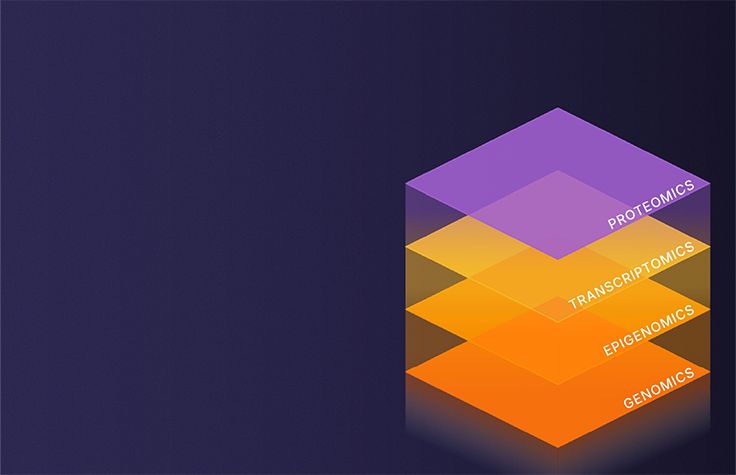
In the last two decades, scientists have gone beyond genomics, dissecting the genome’s molecules and analyzing how they interact. In doing so, we have created entirely new disciplines: genomics, transcriptomics, proteomics, epigenomics, and others. Collectively, they are called multiomics, which takes a systems approach to molecular biology, recognizing that any single ome will only reveal one piece of the larger puzzle.
What multiomics can tell us
While each specific ome has its strengths, it can also leave information on the table. A multiomics approach unifies these linked molecular processes, providing more complete insight about the mechanisms that drive biology, health, and disease. Multiomics can offer a cohesive, connected view across genomics, proteomics, epigenomics, transcriptomics, and so on.
Genomics is an excellent way to study genes, including both coding and noncoding regions of the genome. However, knowing the sequences of all 20,000 human genes does not reveal which of these are being expressed at any given moment.
In addition, when a gene is transcribed, mRNA coding regions are often spliced together in different ways (splice variants) to produce distinct proteins with different jobs. Sometimes, those variations are substantial. Genomics does not reveal those splice variations but transcriptomics can.
Transcriptomics identifies which genes are expressed and how the mRNA is spliced. Spatial transcriptomics resolves gene expression patterns within the tissue.
Still, mRNA transcription does not necessarily mean a protein will be created. Cells have numerous regulatory mechanisms that prevent mRNA transcripts from completing their missions. Proteomics shows which proteins have been synthesized, and what they look like.
This is particularly important in biologic molecules because form is function. Knowing how a protein is folded is just as important as seeing how its component amino acids are arrayed. Each shape tells a story.
Even after proteins are synthesized, they undergo a process called post-translational modification, during which cells add different molecules to enhance function. Phosphorylation, for example, is a critical modification that adds a phosphate group to activate proteins, particularly enzymes. Genomics and transcriptomics will not reveal this important detail, proteomics will.
Like a computer operating system, the epigenome precisely regulates gene expression, making the static genome far more dynamic. Perhaps most importantly, the epigenome reacts to environmental cues. As a result, epigenomics can provide essential data on how environmental factors influence expression.
For multiomic studies, researchers can elect various multimodal techniques. Bulk sequencing can pool cell populations, tissues, and other samples to arrive at an average measurement. Single-cell sequencing is an advanced method that allows analysis of omic sequences at the resolution of individual cells—ideal for evaluating the heterogeneity of populations. Finally, spatial sequencing offers a contextual view of cell activity and information as it combines omic information within intact tissues.
Click here to download Illumina’s Multiomics eBook.
Multiomics helps us understand how all these layers work together as a single cohesive system. This information helps researchers visualize how cells make decisions and how diseases can force different choices.
Illumina’s approach to multiomics
Illumina supports multiomic research through a combination of library preparation workflows, high-throughput sequencing platforms, and analysis solutions. We strive to provide full ecosystem of insights. Application-specific library prep methods enable genomic, transcriptomic—including single-cell and spatial—and epigenomic assays, which can be sequenced on systems such as the Illumina NovaSeq X Series. These sequence-based datasets can then be combined with complementary modalities, including proteomics, in downstream analytical frameworks.
Illumina’s vision is about enabling a full suite of omic modalities on our core platforms, driving greater access to these approaches—without customers needing to acquire numerous types, or successive models, of instruments. Researchers enjoy a complete workflow advantage, efficiently moving from sample to answer.
Some of our newest innovations include our 5-base solution, which provides simultaneous methylation profiling and high-accuracy genetic variant calling.
Illumina SomaSeq™ Discovery, formerly known as Illumina Protein Prep, brings protein analysis into a sequencing-compatible workflow. This technology allows researchers to convert protein measurements into NGS readouts. Illumina SomaScan™ Discovery, formerly known as SomaLogic SomaScan® 11K Assay, converts protein measurements into microarray readouts.
StrataMap Spatial, previously called the Illumina Spatial Solution, is an end-to-end sequencing-based research solution to uncover spatial insights. Spatial transcriptomics is already a critical tool in developmental biology, neuroscience, and oncology research. StrataMap Spatial expands researchers' ability to map tissue structure, reveal tissue function, track tumor progression, and identify novel drug targets for precision medicine.
While NovaSeq and other technologies produce multiomic data, Illumina is also developing tools that rapidly analyze this information and streamline interpretation, including DRAGEN secondary analysis and Illumina Connected Multiomics (ICM).
ICM harnesses artificial intelligence to both integrate diverse omic datasets and help investigators separate signal from noise. This technology helps researchers mix and match data types—genomic, proteomic, spatial, single-cell—for a truly integrated view of biology. In addition, ICM provides critical biological context, connecting lab data with large, curated databases through the Illumina Correlation Engine and other resources.
How researchers use multiomics
One of multiomics’ main advantages over any single omic discipline is that it can help scientists move beyond correlation to identify causation. This can make a profound difference in how we understand biology, develop diagnostics, find potential therapeutic targets and develop medicines that modify those targets.
· Illumina and Broad Clinical Labs are harnessing multiomics tools to develop a massive cell atlas to accelerate disease modeling and drug development.
· In an early-stage study, Bodour Salhia, PhD, professor of Cancer Biology at USC, used a combination of epigenomics, transcriptomics and proteomics to improve accuracy in ovarian cancer diagnostics.
· Researchers at Oxford and Cambridge are using multiomics to differentiate CD4 T cells and better understand the immune system.
· This multiomic research, led by Emory University, combines genome-wide association studies with proteomics to view Alzheimer’s pathogenesis.
· Scientists in Oslo are adding methylation biomarkers to liquid biopsies to improve their accuracy.
The promise and potential for precision medicine and other applications
Multiomics has tremendous potential to vastly improve drug discovery. By comparing disease signatures from different parts of the genome/transcriptome/proteome/epigenome, researchers can visualize the entire pathway and study how specific drugs can modulate it.
This could reveal side effects early in the discovery process, rather than in late-stage clinical trials, as well as boost efficacy. It could also help clinicians understand why some patients respond to a medication while others do not.
Now, investigators can follow the entire continuum of cellular information—from genome to proteome and beyond—to see how tissues operate. It’s like getting a brand-new user manual for cell biology.