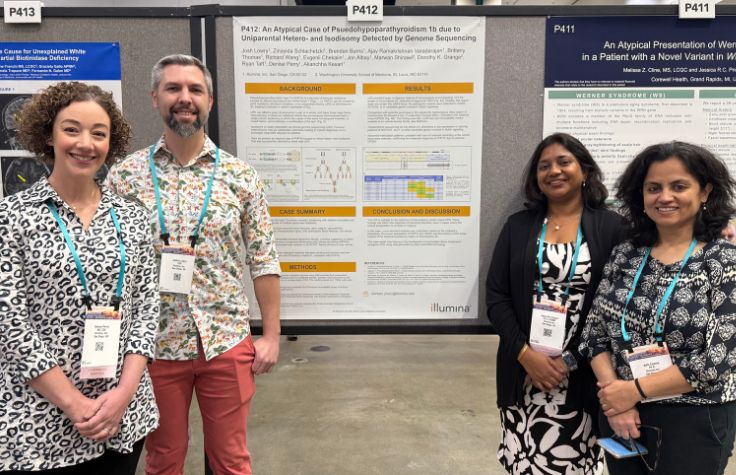
Interrogating challenging genomic regions provides new answers for patients
At ACMG 2025, Illumina demonstrates how whole-genome sequencing and improved bioinformatics has solved cases of rare genetic disease.
Empower the journey from association to causality
Complex diseases are caused by a combination of genetic and environmental factors, many of which are not fully understood. Although some complex diseases can be highly heritable, many do not follow specific, clear models of inheritance and are not often the result of a single mutated gene. In fact, > 90% of disease associated variants are located in non-coding regions of the genome.1 Roughly 5% of complex diseases are caused by monogenic inheritence, while the vast majority is polygenic.2 Autoimmune and rheumatic diseases, atherosclerosis and many forms of heart disease, neurological disorders, and psychiatric disorders are all types of disease that fall into this category.
Given their multifactorial nature, researching complex diseases has proven challenging. Luckily, genomics technologies, including arrays and next-generation sequencing (NGS), are helping accelerate research and are paving the way to achieve greater understanding of disease etiology and, hopefully one day, the diagnosis, treatment, and prevention of these diseases.
Genome-wide association studies uncover common and rare variants associated with disease
A polygenic risk score represents an approximation of an individual’s genetic risk for disease, based on the sum of the risk alleles for a disease trait, relative to the population.
Polygenic risk scores have the potential to:

Differential expression analysis measures changes in gene expression under different conditions or in response to determinite stimuli.
Expression analysis by RNA-Seq provides:
Quantitative trait loci (QTL) analysis identifies molecular markers that correlate to a quantitative change in a particular trait or dynamic outcome.
QTL analysis provides:
Epigenetic analysis elucidates the biological mechanisms that alter gene activity resulting from non-coding variation and the environment.
Epigenomic analysis provides:
Interrogating challenging genomic regions provides new answers for patients
At ACMG 2025, Illumina demonstrates how whole-genome sequencing and improved bioinformatics has solved cases of rare genetic disease.

Single-cell analysis is advancing insights in developmental biology
A computer scientist transforms the world of biology by making bioinformatics tools available to all.

Driving genomic innovation at ESHG 2025
Watch how Illumina is advancing genomics with constellation mapped read technology, spatial applications, and single-cell CRISPR, at ESHG 2025 in Milan, Italy.
Interested in receiving newsletters, case studies, and information on complex disease genomics?
Your email address is never shared with third parties.