December 16, 2025
To build Illumina’s award-winning sequencers, top talent in engineering, UX, operations, and manufacturing come together to design and bring a device to market. Developing assays, the molecular biology tests used in DNA sequencing, demands a rare blend of skills: histology, microscopy, sequencing, bioinformatics, and a deep knowledge of biology. “Not every person is an expert in any one of those things,” says Chris Beierschmitt, senior scientist at Illumina. “But everyone’s altruism and willingness to work together and fill in the gaps at any given time—I think that’s the most inspiring thing to me.”
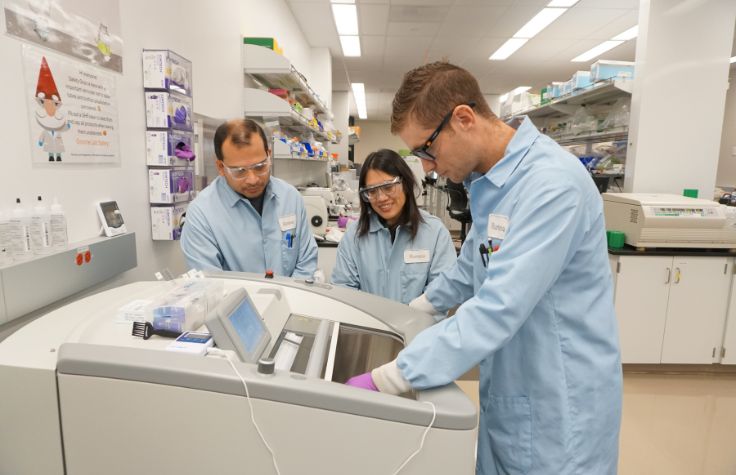
Chris and his colleagues, Anustup Poddar and Andrea Manzo, are part of the core assay R&D team at Illumina, actively shaping the future of RNA sequencing—including innovations in spatial transcriptomics. Anustup played a key role in successfully running the first working model of Illumina’s transcriptomics solution—a groundbreaking spatial assay technology that enables researchers to understand not only which genes are being expressed, but precisely where they’re expressed within a tissue sample. In the past, spatial transcriptomics solutions forced researchers to choose between breadth of coverage or high resolution. Illumina’s approach combines both, providing consistent performance on a capture surface designed to handle a range of tissue sizes and shapes.
By slicing thin tissue sections and capturing RNA transcripts on a specialized glass slide, scientists can map gene activity with remarkable spatial resolution. The applications for spatial transcriptomics are vast; the technology can be used to study human, animal, and plant tissues, supporting both research breakthroughs and clinical advancements in precision medicine. This level of detail opens doors for understanding complex biological systems, including disease mechanisms, neurobiology, and oncology.
This month, a select group of customers will receive early access to the product, which launches officially next year. Anustup is eager to see how researchers will leverage the technology to uncover new biological insights and push the boundaries of discovery.

A culture of collaboration—in and out of the lab
At Illumina’s San Diego headquarters, the assay team’s work spans research, development, and product launches. Andrea, who leads Chris and Anustup, reflects on their growth: “Just three years ago, they were fresh out of grad school and now they’re very well-versed in the industry and how you make a product,” she says. “I really enjoyed watching them learn and manage the challenges that have come our way.”
What sets this team apart isn’t just scientific expertise—it’s their commitment to supporting one another. “There’s always somebody coming by to help you out.” Chris says. “And I think that’s what makes this team special to me.”
That shared spirit of success defines this trio of scientists. Over the past three years, they’ve done more than just shape cutting-edge technology—they’ve built a culture of trust, dedication, and mutual support.
Giving back through mentorship and volunteering
Both Anustup and Chris credit their success in the field to mentors who encouraged them to pursue science. Anustup recalls a pivotal moment in high school when his teacher asked him to work on a class science project measuring the speed of light using Foucault’s method—a challenge that led him to design and construct several components from the ground up. “It was well received,” he says. “I was like, okay, I’m kind of good at this, maybe I can keep pursuing it.”
Today, they’re paying it forward. At the annual San Diego Festival of Science and Engineering presented by Illumina, they volunteer to engage young minds—from teaching kids how to pipette, to demonstrating how proteins are made through interactive puzzles—and take pride in seeing future STEM leaders show excitement and curiosity about science.
Illumina’s 2024 Corporate Social Responsibility (CSR) Report highlights this spirit of service: employees supported more than 1,300 organizations through donations and volunteerism, achieving the highest-ever participation rate in employee volunteering. One of the most popular activities? Introducing local students to genomics. “I think Illumina Cares and our Corporate Social Responsibility board make it easy to participate in things that are fun, and not something that becomes a second job,” Chris shares.
This year, Andrea brought her three young kids to Illumina’s Take Your Kid to Work Day event, where Chris and Anustup also volunteered to teach the next generation about genomics.

Chris and Anustup’s dedication to giving back extends well beyond the labs of Illumina. In addition to volunteering at company-sponsored events, they each devote personal time to causes they care about. Anustup regularly volunteers for Habitat for Humanity, and Chris contributes to science education with Discovery Education. He was recently featured in the latest DNA Decoded Virtual Field Trip from Illumina and Discovery Education highlighting how genomic sequencing is used in scientific research.
Building breakthroughs together
As a team leader, Andrea is now applying lessons from spatial assay to single-cell technology, helping expand Illumina’s product offerings. The team's work is vital to Illumina's focus on advancing multiomics, an integrated way for researchers to combine genetics with other important biological processes. Whether celebrating a project win with a happy hour, competing in a cook-off, or playing a round of pickleball, this team is proving that innovation at Illumina is about more than data—it’s about the community of people you collaborate with, the mentors who guide you, and the students you inspire.
To learn more about Illumina’s Corporate Social Responsibility programs, click here.