February 16, 2026
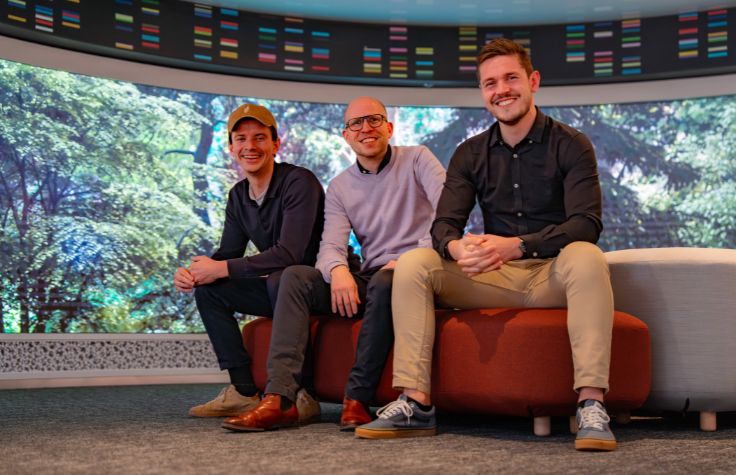
Last month, Bart Verstrynge and Thomas Beuls flew from their homes in Brussels to San Diego, California for the International Plant and Animal Genome Conference. They were representing their company, Breed Bio. Established just two years ago, the startup is already helping to improve agriculture programs with its modern and sophisticated Laboratory Information Management System (LIMS).
“Leveraging agrigenomics data is not a nice-to-have anymore. It’s here to stay. It’s at the heart of the modern plant and animal breeding program,” says Bart Verstrynge, Breed Bio CEO and co-founder. At Breed Bio, they have developed a LIMS tailored for breeders and farmers, as they believe the current market offerings should be easier to use, more scalable, and built specifically for breeding programs and seed quality processes.
Predicting traits and health
Agrigenomics companies use genotypes to make predictions. “In human diagnostics, we might call this a polygenic risk score—essentially, quantitative prediction from a model, given a set of genotypes,” says Breed Bio CCO and Co-founder, Thomas Beuls. “For agrigenomics, we might ask, ‘Is this going to be a better dairy cow or meat cow? What is the estimated yield value for this corn plant?’”
A breeding program is about making selections, then perfecting plant varieties. “That’s a very different use case from human genomics. You’re not going to select humans,” says Verstrynge. “You want insight into all the variants in a person that’s alive and already there, and you want to get to medicine. A breeding program is less about discovery—you’re intentionally making selections within a smaller set of choices.” A researcher might plan to start out with one parent line, cross it, and then move to the next phase and cross again. It can require many more samples and multiple phases. “There’s a whole supply chain of data that you need throughout a breeding program, and many demands for genetic information throughout. The average plant variety idea is conceived in year one, but depending on the crop, only brought to market 10 to 15 years later.”
This was the impetus to start Breed Bio. Drawing on their background in clinical diagnostics, Verstrynge and Beuls recognized the need for a LIMS built specifically for agrigenomics rather than adapted from other industries. Their focus was clear: support ultra-high-throughput laboratories where millions of samples must move predictably and efficiently from intake to insight. Their software delivers seamless data management across the entire workflow, from sample registration to actionable breeding decisions. “It’s an optimized flow for what a breeder ultimately needs: highly reliable, high-quality genetic information at a very economical cost,” says Verstrynge. “That’s also why customers value arrays so much. They combine robustness with a predictable cost per sample.”
Man vs. nature: How studying agriculture differs from humans
- In a plant or animal program, species can vary
- Sample collecting might depend on the season
- Number of samples is much larger
- Labs must be flexible and accommodate different types of content
What is a microarray?
A microarray is an array‑based technology containing thousands or ten-thousands of predefined DNA markers that can be analyzed simultaneously in a single assay. It is commonly used to generate genotypes for a specific set of markers, enabling high‑throughput and consistent characterization of genetic variation.
Microarrays are now used at scale by a wide range of breeding organizations—not only seed companies but also livestock and aquaculture genomics programs. But as breeders are scaling up microarray workloads, service labs are struggling to manage the data and integrate it. Breed Bio is building its software for scale—this is key as labs request mid- and high-density microarrays, which generate much more data.
Verstrynge and Beuls describe their customers’ laboratories as data factories, receiving samples from multiple sites and processing them at industrial scale. Annual volumes range from 100,000 samples to several million, where success depends less on discovery and more on consistency, process control, and operational efficiency. In these environments, every step must be predictable and traceable. “That’s where our platform really shines,” says Verstrynge. “It guides the lab forward, removes manual work, and always knows what the next step should be, without getting in the way.”
Through a new co-marketing collaboration, Illumina will work with Breed Bio to demonstrate the compatibility of Breed Bio’s software and Illumina’s custom and high-throughput microarrays, which deliver robust, scalable, and cost-effective genotyping. Breed Bio’s software connects the wet-lab and dry-lab workflows into one continuous process. The combination of this software and Illumina’s microarrays platform supports the full array workflow, from sample intake and plate preparation to chip runs, data processing, and delivery of clear, actionable results to the breeder.
The future of breeding programs and Breed Bio
In 2026, Breed Bio’s largest customers are focused on even greater automation and scale. Modern agrigenomics labs increasingly operate around the clock, with instruments running overnight and minimal hands-on intervention. “Labs want systems working at 3:00 in the morning without a person being there,” says Verstrynge. “We provide a continuous, optimized flow of data production with the same level of quality and traceability you’d expect from someone manually checking every step, but at a much higher throughput.”
At the same time, the scientific challenges themselves are becoming more demanding. Many of the simpler, single-gene traits, such as certain disease resistances, are already well understood and can be resolved with just a handful of SNP markers. Breeders are now turning their attention to more complex, quantitative traits like drought tolerance, yield stability, and nutritional value. These characteristics are influenced by many genes and require far more markers and far more samples to model accurately.
This shift makes high-density arrays and sequencing a permanent foundation of modern breeding. “To improve complex traits, you simply need more data,” says Verstrynge. “More markers, more samples, and consistent, high-quality results. That’s what allows breeders to make better decisions earlier in the cycle.”
As the Breed Bio team continues to grow, they see agrigenomics entering a new phase of maturity. “For a long time, technology for agrigenomics teams was derived from human genomics because, naturally, we tend to focus on ourselves first,” says Beuls. “The time is ripe for agrigenomics to demand the same quality and scale.” Smiling, he adds, “We believe the food of the world is important enough for high-quality software and genomics tools.”
To learn more about agrigenomics, follow this link.